

Voice and Vision

This is an old manuscript of mine that has just been gathering dust for the past quarter century. It is based on a presentation I gave at a conference we were hosting while I was at the University of California, Irvine, way back in 1999. The conference was called “Reclaiming Voice II: Ethnographic Inquiry and Qualitative Research in a Postmodern Age,” or, simply, “Reclaiming Voice II.” I’m far from what I would consider a postmodernist, but as my department was hosting the conference, I felt behooved to contribute. If there is anything I admire about postmodernism, it is its playfulness, and as you can see, I took full advantage of that. I was also emboldened by a conversation I had with my esteemed colleague at UCI at the time, Jacques Derrida, from whom I was able to publicly extract an acknowledgement along with an albeit qualified admission regarding the existence and importance of Kant’s noumenon. Hence the dedication.
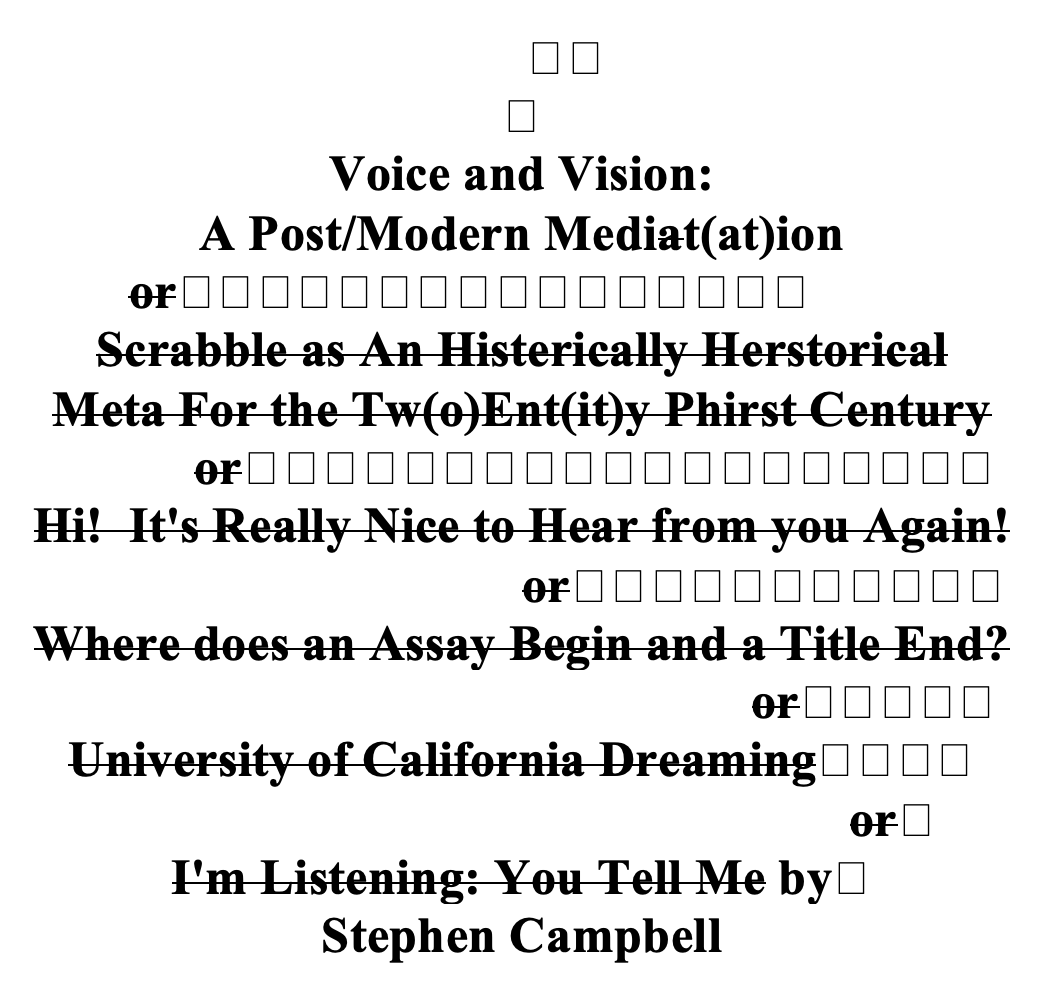
Dedicated to Jacques Derrida
Stream of consciousnessing can be a dangerous thing. Sometimes we find ourselves in new places with no idea of how we got there or why. Then, like awakening from a dream, we find ourselves back to someplace more familiar. Ah, yes, that is what I originally had in mind..., Spontaneity! I must stick to the plan. I wanted to take this wonderful opportunity to focus on reclaiming my OWN voice and found my imagination running wild with the wonders of word processing. So many incredible possibilities. Voice and Vision flow in a cosmic dance. In the beginning was the Word, and before that God said, "Let There Be Light" and made Man in His own Image. Isn't it paradoxical? The Word sounds so definitive and the Image, and the means to See it, appear so arbitrary. For those who have ears, let them hear! Petitio principii? Word has it that once the ancient Greeks combined papyrus with the Semitic alphabet that things got all turned around. The Word became Image, and Vision laid claim to Voice. So it is written, and now I'm telling you. It's a theory, actually. But there is more to this than meets the eye..., shhh, listen...
Movement, transience, transcendence, full stop. Transcendental, essence, existence, go. Y = 2K + 1. Where do we go from here? From modernism to postmoderism to...??! Does everything go? Will anything grow? California, where appearance is more than skin deep. Ah, California: everything grows & anything goes—Mother Earth scrapes your plates! If, according to Derrida, America IS deconstruction, then where does that leave California? America IS deconstruction, according to Derrida, therefore, where does that leave US? Logic fails. QED. Of course, Frege would say this is a psychological problem.
Crisis? What crisis? By way of introduction, let me introduce myself. I am concerned. How do you do? To be more specific, I am concerned about the positive and the negative. I am concerned about the great and the small, the more and the less, the good and the bad, the righty and the mighty, the ying and the yang. I confess. I am a mathematics educator, albeit a philosophically oriented one. I am Pythagorean and proud of it.
I am a vision with a voice and a voice with a vision. I guess that makes me hetero-something. If commutativity holds, I might even be hetero-something-squared. Ironic, given commutativity tends to homogenize differences. Queer really, or just, really queer. I'm sure Wittgenstein must have scribbled more than a few aphorisms on that. If it sounds like I am trying to square the circle, I'm not. I commiserate with incommensurability. Enough about me, whatever that is. I have a story to tell, and I want to spell it out for all to see.
This is a story about Being and Becoming. It is also a story about a propensity towards a hardening of the categories, and our very good fortune, despite the best efforts of science and technology, that our species has yet to die of cardiac arrest. Full stop. Unfortunately, too, way too, many already have. How "unbecoming" of us! So allow me to ignore that. I wish to stay on topic. I am trying to restrict my medication [sic] to vision and voice. To dwell too deeply on matters of vitality and virtue may be more than I can bear right now. This story is definitely going somewhere, I'm just not sure where it will end, except that it will. Destination unknown? I am uncertain of that! Time and Space die hard.
Along the way I feel the push and pull of science and religion. Philosophy be my guide and mathematics my compass: help me navigate through the whims and willies of causal teleology; help me remain constant in this sea of change. Wait a minute, I can hear a little voice saying "help me adapt to this unrelenting turmoil." So, what's it going to be? Must I make a choice on this one way or the other? Ah, the human condition. Isn't that what this paper is about? But no! What on earth makes humans so special. Maybe that's it! Earth, that is. But isn't this paper really about manifesting a universal condition? Aren't ALL things concerned with such things? Wait a minute! I imagine other voices saying they aren't the least bit interested. My God! What if my audience walks out on me... Oh No! (Must I worry about that, if it is my voice I hope to reclaim? Can there be any absolutes for all of my relations? Am I compelled to speak as two?) Wait! Please..., listen..., you will see…
What is the I/WE to think about all this? Presuming that you, dear listener, have not already rejected my "voision" in exasperation. What are the respective contributions of voice and vision to thought, both literally and figuratively? Surely it is no coincidence that the spoken word is prone to transience while the written word provides a greater sense of permanence. Linguistically, can there be any greater distinction than that between verb and noun? Perceptually, can there be any greater distinction than that between sound and sight? Functionally, can there be any greater distinction than that between process and object? Existentially, can there be any greater distinction than that between becoming and being? Okay, possibly life and death... but like I said, that is a bigger story than I want to deal with. Phenomenologically, can there be a greater distinction than that between voice and vision? Hmm, okay. Probably quite a few. But those would be other stories as well.
Notions that entail, implicate, or are regularly associated with each other tend to cluster like grapes. Transience; verb; process; becoming: VOICE! Permanence; noun; object; being: VISION! Bandura refers to this clustering effect, where different notions are held together in some form of mutual relation, as reciprocal determination. Lévi-Strauss calls attention to the conceptual spaces opened by binary opposites. As slippery as slip-sliding away into structure can be, we have a logical compulsion to do so. How can we constrain thoughts without constraints? In collecting pairs of binary opposites in two reciprocally determined clusters relating to voice and vision, I have no intention of (im/pro)posing a new set of categories. Rather, I wish to explicate some of the cognitive co-dependencies of these sensorimotor modalities; to enact some of the regulative, normative, and metaphorical manifestations of our embodied constitutional nature.
The transcendental unity of apperception, Kant argued, is a necessary condition for the possibility of experience. This is the binding problem. How can we account for, or give voice to, our ability to coordinate the manifold thirsts, thoughts, and thew of our flesh? Chasm or chiasm? I, with Merleau-Ponty, opt for the latter. In this paper, I meditate on vision as a state of being and voice as an act of becoming. I dwell within the fact that voice without vision is blind, and vision without voice is dumb. I reflect on ways in which this fact can help to mediate contemporary debates between absolutists and relativists, modernists and postmodernists, theorists and practitioners, alike.
Method and Motivation
The foregoing, possibly maddening, introduction to this paper, with minor alteration of a couple of words here and there, constituted my proposal for this conference. I see my task at this point to be one of explaining and fleshing out whatever the heck it was that I was trying to say at the time I wrote it, and why I was trying to say it. Indeed, the main point of concern for me, and perhaps dear listener for you also, is whether or not there actually was an "it" that I had in mind. I will try to convince you that there really was a theoretical and speculative object(ive) behind my words, one that I can actually see and believe to be true-in an old-fashioned sense of that term. That is to say, in giving voice to my vision, there remains a vision within my voice. I have no aspirations to demonstrate the priority of vision over voice, or to plead a case for voice over vision. Rather, I wish to argue that although there are crucial differences between the two, there is something deeply important unifying them as well. The important question is, what might that be?
To distinguish is to annihilate a pre-existing phenomenal unity, creating plurality. Merleau-Ponty notes that the first objective distinction is the self-conscious awareness, or apperception, of our own body as a distinctive object within a world external to the body. Distinctions originate with subjective cognitive acts which simultaneously give rise to external objective realms. According to Anaxagoras "all things were together; and mind separated them and put them in order." As Kant would later realize, all external objects are unified by the subjective acts giving rise to them. A transcendental unity of apperception asserts itself as the necessary ground for experiencing a unified world out of a plurality of sensations. How are we to understand the relationship between unity and plurality? Are they incommenserable concepts in some literal or metaphorical sense of that term. One may very well think, as Lyotard, there is some sort of "differend," some irreconcilable differences between the two, that renders any hope of resolution fruitless, pointing to the meta-theoretical heart of the differences between modernists who seek such unifying frameworks, and postmodernists, who no longer seem to bother and no longer even seem to care.
Is there but one true account, or "meta-narrative," of our individual and collective experience of the world, or are there many (or more radically, none at all)? I, along with Socrates and many others, wonder if such a unifying framework can or ever will be achieved, but we know we are much better to strive for such understandings than not. Such is my aim here. As Nietzsche so aptly noted regarding the early philosophers of ancient Greece, I shall strive to speak in a language postmodernists can grasp, yet I must also speak to the eternal, in a language not yet theirs.
Striving to "move beyond" traditional philosophical differences, as many pragmatists and postmodernists these days seem wont to do, should not serve as an excuse for abandoning attempts to "get beneath" those differences—to smoke out their nature and origins in an attempt to understand, or better yet, to stand or simply reside under them. What are the philosophical differences underlying modernism and postmodernism and, perhaps more specifically, quantitative and qualitative research? Why are they there? How did they come to be? What can we learn from them? Should they be reconciled? Can they be?
Some anti-essentialists may find it surprising to find that even Husserl, the arch-essentialist himself, has pondered such questions. Indeed, he went so far as to suggest that the relative and absolute depend, necessarily, upon each other, perhaps simply intertwined as a conceptual rather than a perceptual gestalt. Why should it not be possible to simultaneously accept apparently contradictory concepts and meanings expressed by fundamental philosophical terms such as absolute and relative, necessity and contingency, unity and plurality, and so on, without risking the dialectical limitations of modernism, or suffering the rhetorical excesses of postmodernism? Questions such as these can be fruitfully considered and informed by reflecting on their incipience in ancient and classical Greek mathematical philosophy.
Plato noted long ago that the soul, when touching upon anything which has being, "is stirred through all her powers to declare the sameness or difference of that thing with some other" (Timaeus, ~360 BCE/1961, 37a, b). This will be my first task: to explore some similarities and differences with respect to vocalizing and visualizing number. According to Aristotle "ordinary words convey only what we know already; it is from metaphor that we can best get hold of something fresh" (Rhetoric, ~330 BCE./1924, 1404b). My second task, then, will be to apply my reflections and inflections on vision and voice metaphorically in an attempt to get a fresh hold on the contemporary debate between modernism and postmodernism. I claim the seeds of this debate precede Plato and Aristotle, preceding as well that infamous icon of irony, the gadfly of Athens himself, and in actuality are manifested and exemplified in the ancient mathematical philosophies of Pythagoreanism. My third task is to argue, having drawn throughout upon the insights of Merleau-Ponty, that this debate ultimately collapses into a unified state of lived embodiment and, moreover, may be informed, if not resolved, by phenomenological and mathematical analyses of various chiasms of constancy and change, light and dark, self and other, one and many, divisible and indivisible, discrete and continuous, decidable and undecidable, discernible and indescernible, between primordial experiences of sight and sound, and ultimately, between ourselves and our embodiment within the All-That-Is, which I shall take as encompassing the entire known universe and whatever is beyond.
Visualizing and Counting
The fundamental language concerning external objects in general is arithmetic and the elements of this language are number and unit. On the surface at least, it would appear that unity and plurality have had no problem peacefully coexisting within the concept of number for millennia in the field of mathematics, despite being in obvious conflict with Liebniz’s principle of the identity of indiscernibles. Under the surface, however, within the historical, psychological, mathematical and philosophical origins of these concepts, things may not be quite as peaceful as they seem. I wish to suggest that the notions of unit and number, unity and plurality, can be fruitfully considered with respect to the two reciprocally-related grape-like clusters of concepts I alluded to in my proposal that are evidently quite closely associated with voice and vision. Such considerations may, in turn, serve to help resolve, or even better yet, simply dissolve troublesome conflicts and differences between modernism and postmodernism.
According to Euclid, the ancient Pythagorean definition of a number is a plurality of units, where a unit is "that by virtue of which can be called one." By virtue of which a thing can be called one imparts an objective sense, or integrity, upon the thing being distinguished. The objective unity of the arithmetic unit, however, is but a shadow of the pre-reflective unity existing prior to the subjective act from which it originated. Again, as Kant would eventually come to realize in his forms of perception, subjective acts occur sequentially in time while external objects exist simultaneously in space. Arithmetically this difference constitutes a fundamental difference between ordinality and cardinality. Units comprising an ordinal number are invoked sequentially in time as separate entities, whereas units comprising a cardinal number are envisioned simultaneously in space as a reconstituted unity.
This condensed analysis of number accentuates some important binary oppositions: unity-plurality; subjective acts-external objects; sequential-simultaneous; ordinality- cardinality; time-space. The terms sequential-ordinality-time and simultaneous- cardinality-space again form reciprocally related clusters of concepts. I wish to emphasize here the subjective acts of vocalization for counting ordinal numbers and visualization for the apperception of cardinal numbers. These acts suggest the sensorimotor modalities of perception most closely associated with two phenomenological clusters of binary opposites underlying more abstract notions of arithmetic units and numbers.
Counting as a sequential act of vocalizing is clearly associated with ordinality. Simultaneously visualizing a plurality of individual external objects as a collective cardinal unity is fairly clear as well, at least for small numbers, say up to about ten. However, visualizing larger cardinal numbers of external objects, such as 197 bottle caps, or 342 toothpicks spilled on a carpet, although possible for some savants, remains deeply problematic, if not completely impossible, for most people. Indeed, as Husserl has pointed out, perception alone is an insufficient basis for comprehending the arithmetic of arbitrarily large numbers, for even the most exceptional of savants as well. Be this as it may, the common and familiar phenomena of visualizing a small definite plurality of external objects as constituting a cardinal unity will suffice for my purpose here. Mathematical thinking naturally encapsulates process as object.
Relating this formidable distinction between subjective acts and external objects to reciprocal clusters of concepts indicated above—sequentiality-ordinality-temporality and simultaneity-cardinality-spatiality, which seem respectively associated with the vocalization and visualization of small quantities—is less evident, as each implicates both. Vocalizing and visualizing both implicate subjective acts over external objects. However, except for the degenerate case of a single object vocalized, to oneself or out loud, as "first," or visualized in its cardinal sense as "one," there is an important difference with respect to temporality. This is because ordinality involves a plurality of sequential acts, whereas cardinality culminates in a spontaneous act of synthesis of a small plurality into unity. The latter spontaneous act simultaneously "covers" a small quantity of spatially distributed external objects. The spontaneity of this apperception (as a conscious awareness of a perception) lends a sense of constancy to the act of cognizing small cardinal numbers. The sequentiality of counting, on the other hand, lends a sense of temporality to ordinal numbers.
Thus, the distinction between subjective acts and external objects reinforces the temporal orientation to the vocalization of counting while lending a important sense of atemporality to the apperceptual visualization of cardinality. The orientation of vocalization and counting is toward process whereas the orientation of visualization is toward object. That is to say, a procedural emphasis on counting ordinal numbers is given toward each unit in turn, whereas an emphasis on visualizing cardinal numbers is given toward the objective synthesis of individual units as a collective unity. Although the vocalization of ordinality and the visualization of cardinality both depend upon subjective acts involving external objects, voice seems more naturally oriented toward the act and vision seems more naturally oriented toward the object.
In the singular act of visualizing a small cardinal number, the act itself becomes transparent, and the plurality of units comprising it are synthesized into a unity. In the sequential acts involved in counting, the acts themselves are more apparent, and the individual identity of each of the plurality of units involved is maintained. Thus, it seems that plurality and subjective acts fall more naturally into the cluster of concepts associated with voice and that unity and objective objects fall more naturally into the cluster of concepts associated with vision. We can readily add to these clusters of binary opposites associated with voice and vision respectively: change and constancy, verb and noun, transience and permanence, becoming and being, and so on.
Modernism and Postmodernism
I sense that now some postmodernists may be losing patience with me. My introduction of reciprocally related clusters of binary opposites associated with voice and vision may be viewed as a manifestation of the bivalent modes of thinking postmodernists wish to deconstruct, undermine, muddle, or outright reject. Perhaps there is some solace to be found in that embodied action is taken as antecedent to the subject-object dichotomy; a dichotomy I take, with Merleau-Ponty, as one emerging with the apperception of embodiment. This offers a distinctive phenomenological twist to the Kantian prioritization of the act. Although speculative theoretical objective knowledge has recently become engaged if not yet joined in formal wedlock to the body, it continues, according to Nietzsche's indictment, to kill the act which fathers it. A fact, ironically, to which it remains blind. If postmodernism can eventually lay claim to the death of tragedy count me in.
Even the most radical of postmodernists, however, would not deny that binary opposites partake in the structuring of our thoughts and experience, so long, that is, as that structuring submits to contingency and is not (mis)taken as a necessary feature of reality. The main point of the previous section was to assemble clusters reciprocally related of binary opposites for a purpose. Not only are these clusters naturally oriented to voice and vision, but they are also deeply manifested in the very heart of mathematics via the concept of number. In this section I will dig more deeply still into the Pythagorean origins of the concept of number in an attempt to gain a fresh hold on the contemporary debate between modernism and postmodernism.
The Pythagorean concept of number was born, to invoke a Joycean term for the occasion, in a chaosmos of sound and light. Light, perhaps it goes without saying, is a necessary condition for vision, whereas sound is a necessary condition for voice (of course, I could be wrong about all that). For the Pythagoreans, as is well known, number constituted the fundamental elements of all things. This rather bizarre belief is by no means as arbitrary and ridiculous as it has so often been portrayed. On the contrary, it was, I believe, both brilliant and profound. It is a principle that, with some refinement, remains with us to this day in the modern guise of mathematical physics. That principle can be loosely stated as follows: mathematics mediates experience and understanding. For the Pythagoreans, numbers, as demonstrated by the harmonic relations of the monochord and the geometric relations of the stars, were in concordance with, and thus served to unify, sense and intellect.
For the Pythagoreans, and modern day quantitative researchers for that matter, the key to a formal understanding of the structure of reality is found in the mathematical relations between numbers. These numerical ratios formed the basis of the rational world. But not all was well in the ancient Greek cosmos. Those Pythagoreans, the Acusmatici, who lent priority to the monochord found harmonic deviations that could not be easily reconciled with the theoretical speculations of those Pythagoreans, the Mathematici, who lent priority to the geometric relations between numbers. Different aesthetic sensibilities appear to have led to a difference in priority between the senses in relation to number, as Plato indicated long ago.
"We may venture to suppose, I said, that as the eyes are framed for astronomy so the ears are framed for the movements of harmony; and these are in some sort kindred sciences as the Pythagoreans affirm and we admit, do we not Glaucon? We do, he said." (Republic, ~383 B.C.E./1961 #1266, 530d, p. 763)
It is not surprising that the Pythagoreans would conceive of numerical units analogously to points of starlight in the evening sky. Nor is it surprising that they would relate music and harmony with the state of the soul. With the study of numbers through geometrical forms such as square and triangles, the mathematici had a visual method through which they could readily demonstrate and agree upon those "mathematical" relations. The acusmatici, however, did not appear to fare as well in their studies. Again, according to Plato:
"They talk of something they call minims and, laying their ears alongside, as if trying to catch a voice from next door, some affirm that they can hear a note between and that this is the least interval and the unit of measurement, while others insist that the strings now render identical sounds, both preferring their ears to their minds." (Republic, ~383 B.C.E./1961 #1266, 531a, p. 763)
Thus, sound offered a less successful medium than light in providing rigorous methodological insights into the study of numbers. Had the reverse been true, we might well be studying "acusmatics" in place of mathematics today. However, I think there may be something much more important to dwell upon than that. The difficulties of the acusmatici would have rendered problematic the concordance between sense and intellect motivating the Pythagorean cosmology. In attempting to identify the true harmonic intervals of the monochord, the acusmatici apparently prioritized sound data given through their ears, akin to postmodernists today, fell naturally into skepticism if not outright cynicism regarding rationality, whereas the mathematici, laying claim to the mind, prioritized theories more demonstrable to their eyes than to their ears in this epic, dare I say, seismic empirical-rational rift.
I don’t wish to imply that it was clear sailing for the mathematici from that point on. It most certainly wasn’t, as all attempts to find the ratio of the side to the diagonal of the square failed miserably. It was eventually realized that ratios between indivisible units were not sufficient to account for all things. With the advent of dialectic, and reconceptualizing the unit as a unit of measure, the mathematici had to admit a dimension of irrationality into the(ir) universe, along with the concept of zero. As for the acusmatici, despite their loss in numbers to skeptics and cynics, I doubt they or their influence and pursuits will ever completely disappear. Throughout the ages, their progeny remain focused, trying to catch a voice, not from ‘next door’, but rather from the music of the spheres, in a never-ending quest for the lost chord. I’d wager many are alive and well today, identifying as jazz musicians.
Ultimately, the eyes eventually suffered a similar fate to the ears with respect to establishing the intellectual credibility of mathematical propositions, particularly with respect to arithmetic. With the development of dialectic, voice reasserted itself and harmony was restored as the authority regarding numerical relations, somewhat ironically, though the discordance of inconsistent reasoning. If a contradiction can be derived from a mathematical proposition, the discordant proposition must be false and its opposite must be true. Thereby harmony, at least in the dialectical guise of consistency, was intellectually restored through the “voice of reason.” Today in mathematics, the stronghold and perhaps the last bastion of modernism, the intellectual necessities of reason continue to hold sway over the empirical contingencies of the eyes and ears, and perhaps of intuition itself.
(Re)assembling California
To embark on my third task—grounding the preceding within the soil of lived experience—I turn now to Merleau-Ponty's pivotal ontological insight of double embodiment: the understanding that we are not merely observers in the world, but beings profoundly of the world, even as the world, in turn, takes shape and meaning within us. This resonant idea of an intertwined existence, where subject and object are not starkly separated but mutually implicating, finds an earlier epistemological echo, and perhaps a seed, in Husserl's epistemological distinction between the natural attitude of unreflective immersion in the world and the phenomenological attitude, which calls for a reflective grasp of consciousness's constitutive role. Taken together, these philosophical perspectives illuminate a fundamental truth of our being, one I've since distilled into my guiding mantra: we are the world within itself. I think it is from this foundational interconnection that we can begin now to reassemble our understanding of voice, vision, and our place within the All-That-Is.
This perceived separation between self and other, between ourselves and the world in which we have emerged, and the world that has given rise to us, is perhaps a necessary consequence of self-conscious awareness. This discovery, or realization, of the quintessential element of mind, finds itself within a constant, dynamic dance with the foundational elements that constitute our world of earth, water, air, and fire. These physical elements are not static backdrops but active participants in the ongoing processes of assembling and disassembling, constructing and deconstructing, embodying and disembodying our world. Their ebbs and flows, their geological processes that assemble California and the Earth itself, to the very breath that sustains our own embodiment, reveal a world in perpetual formation.
This allusion to John McPhee's study, Assembling California, offers more than just a geological history; it offers unlimited metaphors for this constant, dynamic interplay. The accreted terranes, the subduction zones, the relentless shaping by fault lines and volcanic forces – these are not just ancient events but an ongoing narrative of the Earth's 'flesh' continually reconfiguring itself. This terrestrial becoming, so vividly chronicled by McPhee, underscores a planetary-scale embodiment, a world actively 'assembling' itself through elemental forces. Yet, if we pull our gaze back further, this vibrant, self-constructing Earth appears suspended in the deep, echoing silence of our solar system, a lovely lonely pale blue dot, seemingly isolated by countless millions of miles of cosmic vacuum.
Contemplating this immense universe and beyond—the All-That-Is—we might wonder at our capacity to grasp even what would amount to an infinitesimal sliver of its grandeur. Yet, it is here that mathematics, or more fundamentally, mathematical thinking, re-emerges as a profound and revealing human endeavor. This is not merely a system of abstract rules or external truths, but one of the deepest avenues we possess for plumbing the architecture of our own consciousness and that of the world itself, of which we are a part, and that to which we belong. Through it, we discover, realize and construct a priori patterns, principles, relationships, and structures that arise from within our cognitive being. The profound revelation, then, is the uncanny and extensive applicability of this inwardly-derived mathematical thinking into the very fabric of the All-That-Is. This remarkable coherence, this resonance between deep dwellings within our minds revealing dynamic structures of the cosmos, this unreasonable effectiveness of mathematics, does not just hint at, but powerfully testifies to the truth that we are, indeed, the world within itself.
Conclusion(s?)
In a political and philosophical postmodern milieu that justifiably promotes diversity and tolerance over totalitarianism and tyranny, there may also be an unwarranted risk of falling into alienation and anarchy. After all, pendulums do have a tendency of swinging from one extreme to another—especially when one extreme is placed in opposition to another as many modernist and postmodernist advocates often do. There are more civilized ways of carrying on such an important debate. One is to consider whether or not there is some way in which the extremes can be seen as complementary and interdependent, rather than irreconcilable. If so, then the extremes could serve to open a space of possibilities that neither would be sufficient to accommodate in and of itself. This, of course, suggests finding some pragmatic balance between the extremes. After all, such a steady state solution seems to have been recently achieved in the field of education with mixed-methods research.
Indeed, the theoretical debate in educational research that raged throughout the nineteen-eighties regarding the relative merit, worth, and intrinsic compatibility of qualitative and quantitative research methodologies has largely subsided. Garrison's call for the pragmatic practice of "epistemological conservatism and good sense" in educational research appears to have prevailed over more radical and polarized orientations towards distinguishing between quantitative and qualitative research. However, I remain concerned that taking such a pragmatic stance toward philosophical issues underlying differences between such things as realism and idealism, objectivity and subjectivity, truth and meaning, the sciences and humanities, positivism and anti-positivism, modernism and post-modernism, and so on, may also serve to justify uncritical thinking and arbitrary action.
When such philosophical differences manifest themselves in our research, in our teaching, or even in our daily lives, how are we to reconcile them? Need we even do so? Can we safely ignore them? Do we simply agree to disagree? Is "epistemological conservatism and good sense" enough? What does that mean exactly? There is no doubt that we must somehow "move beyond" perennial philosophical differences that have tended to polarize, subjugate, and ostracize people in the past. And pragmatism, at its best, certainly allows us to recognize the value and importance of alternative points of view and to explore the potentialities of alternative courses of action. At its worst, however, pragmatism may also serve as a warrant for acknowledging frangible similarities or ignoring, or leaving unresolved, more tangible differences. If we are to be open to and accept difference with any meaningful sense of solidarity, we must be willing to do more than simply acknowledge those differences and actually engage them.
The romantic and idealistic proclivities of the preceding two centuries, to own up to and overcome our limitations, either through ineffable acts of transcendence or methodological forms of transcendentalism, have in this century been replaced, unfortunately, by a rather unimaginative and uncritical pragmatic acquiescence. Pubescent and adolescent postmodern minds that rely solely on a whole scale rejection of the traditionalist absolutist quests and claims of modernism leave themselves groundless regarding the limitation of others and the legitimacy of their own self interests. The irony of the romantics has been displaced by the irony of pragmatism.
What of the relation between intellect and imagination? The latter seems more related to vision than voice... is that a clue to consider intellect in terms of voice rather than vision. Is there a phenomenological distinction related to voice and vision that relates to dialectic and theory respectively? Is this perhaps manifested in mathematics with respect to different forms of proof as alluded to above? Surely this would imply a much closer kinship between voice and logic than previously considered. Whereof we cannot speak thereof we must remain silent.... Whereof we cannot see thereof we must remain blind? Does that follow? We certainly can imagine what we cannot see, and nowhere would confirmation, certainty, and doubt, carry more currency. Perhaps this provides a clue to how voice and vision have co-evolved, as ‘incarnated vocabularies’, both having likely derived from our primordial sense of touch and their manifestations as feelings. How deep can our feelings go?
Ironically, a postmodernist reclaiming of voice can be seen as a reassertion of a perennial vision, no longer a vision universal in scale, applicable to everything, but rather, one that reasserts a particular, more personal, practical and pressing, sense of epistemic value, ethical virtue, social integrity and embodied vitality. For we can now, on the threshold of a new millennium, better recognize the situated nature of our knowing, the contingency of our acts, the interdependency of self and other, and the manifold anxieties and delights of being human. Thus, the traditional modernist tendency to universalize the particular, be it the true, the good, the just, or the beautiful, can be seen both to make way, and to give way, to a postmodernist tendency to particularize the universal. But haven't mathematicians been doing this for millennia, very much akin to Buddhists, acknowledging the awakened one within the unenlightened, returning us to the embryonics of essence and existence, wherein and therein we may strive to reconnect with our noumenal selves within the All-That-Is? Isn’t this what education, and mathematics education in particular, in its deepest sense, should really be about?
(A few) References
Aristotle. (1924). Rhetoric (W. R. Roberts, Trans.). In W. D. Ross (Ed.), The works of Aristotle (Vol. 11). Oxford University Press. (Original work published c. 335-322 BCE)
Lyotard, J.-F. (1988). The differend: Phrases in dispute (G. Van Den Abbeele, Trans.). University of Minnesota Press. (Original work published 1983)
McPhee, J. (1993). Assembling California. Farrar, Straus and Giroux.
Plato. The Collected Dialogues of Plato, Including the Letters. Edited by Edith Hamilton and Huntington Cairns. Bollingen Series LXXI. Princeton, NJ: Princeton University Press, 1961. (Original work written ca. 360 BCE)
https://substack.com/@janwellmann/note/c-126144661
The heart is where deeper feelings reside...
https://youtu.be/oMA4Stuuvf8