

Educational Neuroscience
Past, Present, and Future Prospects

While researching something somewhat unrelated using google scholar I happened upon this Plenary Presentation on work I’ve done in educational neuroscience that I gave at the 42nd Meeting of the North American Chapter of the International Group for the Psychology of Mathematics Education.1 As articles published in the proceedings are copyrighted by the authors, here it is:2

Good day. I’m pleased to be here to address an area of research that has occupied me for some time, one that has come to be known, somewhat ambiguously, as educational neuroscience. First, a few introductory comments. I have always been interested in the nature of consciousness, and how it is that we are able to experience the world in the way that we do. Oddly enough, back in the 1970’s my industry experience in seismic imaging utilizing the most advanced computing technologies of the time, including one of the first CRAY I supercomputers, led me to the study of philosophy and mathematics. How so? I had come to view seismic imaging as the social construction of a new sense of perception. I blame3 Teilhard de Chardin for that.
During the 1980’s I had the good fortune of encountering a number of books that had a great influence on my subsequent interests and career development, ranging from Haugeland’s edited volume Mind Design (1981), the epic volumes of Rumelhart, McClelland and the PDP Group on Parallel Distributed Processing, to Gardner’s The Mind’s New Science (1987) and Churchland’s Neurophilosophy (1989). These books motivated a shift in focus away from imaging the Earth’s interior to the knowledge engineering of intelligent software systems using neural nets and automated reasoning, and on to graduate studies in neurophilosophy.
I managed to escape the siren call of the oil and gas industry in the early 1990’s and venture west from Calgary to Vancouver to study computing and education at Simon Fraser University, eventually settling into doctoral studies in mathematics education with Professor Rina Zazkis. During those days I was, as were many others at that time, drawn to Varela, Thompson, and Rosch’s The Embodied Mind (1991). Subsequently, after half a decade at the University of California, Irvine, I returned to SFU and obtained funding to establish an educational neuroscience laboratory, the ENGRAMMETRON.4
A good way to begin exploring the manner in which the area of educational neuroscience began is to chart its origins and development through its affiliated Special Interest Group of the American Educational Research Association called Brain, Neurosciences, and Education. That SIG, in its original incarnation in 1988, was referred to as the Psychophysiology and Education SIG. When Bill Clinton5 designated the 1990s as the “decade of the brain,” the SIG was renamed the Brain and Education SIG, promoting “Brain-based Education.” Despite growing popularity of brain-based education amongst educational practitioners, scholars and researchers became increasingly critical, to the point of dismissiveness, citing a number of “neuromyths” that were usually based on partial truths.
Subsequently, in reaction against the growing uncritical educational use of brain-based metaphors, such as right and left brain learners, and appeals to multiple intelligences and VAK (visual, auditory, and kinaesthetic) learning styles (Geake, 2008), the Brain and Education SIG committed to being more rigorously grounded in neuroscience by including that term in 2003. The stated purpose of this newly-branded SIG: “… to promote an understanding of neuroscience research within the educational community [with a] hope to achieve that goal by promoting neuroscience research having implications for educational practice and providing a forum for the issues and controversies connecting these two fields.”
Keynote speakers for the SIG shifted accordingly from champions of brain-based education to neuroscientists themselves with interests in educational problems, august researchers such as Bruce McCandliss and many others.
This AERA SIG initiative wasn’t as novel as it sounds, as an earlier funding initiative back in the 1980s between the National Science Foundation, the Sloan Foundation, and the National Institute of Education enabled scholars and researchers from neuroscience, cognitive science, and education to seek middle ground in what Rita Peterson aptly described as “the middle ground between those three points on a triangle.” One term being bandied about for that disciplinary nexus was “pedagogical neuroscience” (McCulloch, 1989).
One of the main pioneers, perhaps the main pioneer, in bringing cognitive science, neuroscience, and education together and exploring that middle ground in a true disciplinary sense was the recently departed Kurt Fisher of Harvard Graduate School of Education. Professor Fisher founded the Mind, Brain, and Education program at the HGSE, and then went on to establish the International Mind, Brain, and Education Society, as well as serving as the founding editor of that society’s flagship journal Mind, Brain, and Education.
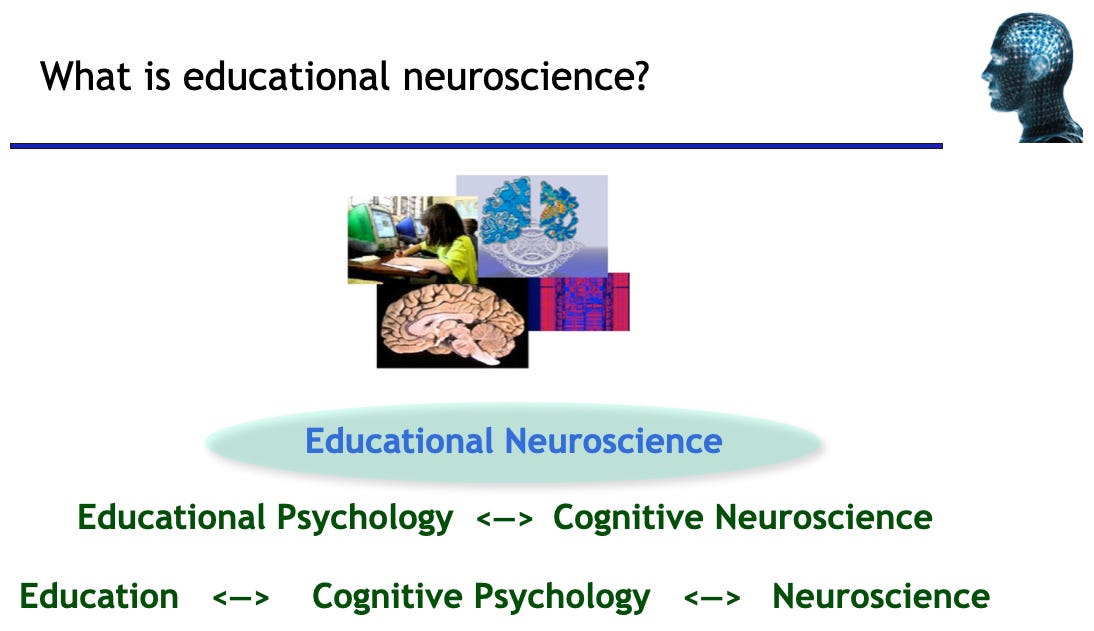
This triangle of disciplines, and the vast areas of research and practice falling within it that they delineate, has come to be known as the new academic field of neuroeducation (Tokuhama-Espinosa, 2008). Within the broad purview of neuroeducation have emerged multidisciplinary, interdisciplinary, and transdisciplinary initiatives. The one that interests and concerns me most is referred to as educational neuroscience. This area of research can be considered in a variety of ways, distinguished perhaps most notably as to where one places the emphasis, educational neuroscience or educational neuroscience. Whereas contributions to the former come predominantly from cognitive neuroscientists, my focus has been on the latter.
Whereas neuroeducation is more broadly conceived, linking as much or more to educational practice, I see educational neuroscience as an area of educational research, and one that naturally draws on the neurosciences, especially cognitive neuroscience and psychophysiology. That is to say, I see educational neuroscience as an area of educational research that draws on, as in being informed by, theories, methods, and results from the neurosciences, but unlike educational neuroscience, arguably an applied cognitive neuroscience, is not restricted to them. This difference is important, as the focal point of educational neuroscience is the subjective experience of learners, not just their associated mechanisms.
In multidisciplinary initiatives where neuroscientists and educators collaborate, there is typically a strict separation between their respective philosophical frameworks and research methodologies, whereas interdisciplinary initiatives typically motivate collaborators to adopt more of a mixed methods approach. Educational neuroscience as a bona fide transdisciplinary activity, by definition, must entail the forging of new philosophical frameworks and research methodologies for bridging education and neuroscience, and especially, mind and brain (Campbell, 2011). Bruer famously referred to this as a bridge too far (1997).
Bridging mind and brain, and body more inclusively, is exactly the aim of Varela, Thompson and Rosch’s Embodied Mind (1991), and Varela’s initiatives in the area of neurophenomenology, to bridge what he referred to as the gap between the biological mind and the experiential mind via “reciprocal constraints” (1996, p. 343). In my view, this amounts to the hypothesis that any changes in subjective experience must in principle manifest objectively in some manner as changes in brain, body, and behavior, and vice versa (Campbell, 2011, p. 10). I have taken this hypothesis as both a foundational assumption and a necessary condition in striving toward a transdisciplinary view of educational neuroscience.
My approach to educational neuroscience in this transcendental sense has been to focus primarily on qualitative educational research rather than quantitative educational research, per se. That is because I am interested more in questions pertaining to ontology than epistemology. That is to say, I am more interested in the lived experience of learners of mathematics than I am, for instance, in how widespread their experience might be in the general population of learners.
That is not to say, however, that I do not draw on quantitative research from cognitive neuroscience, because I do, and it is central to my methodology that I do. As an exemplary case in point, consider the so-called “aha!” moment. Jung-Beeman and his colleagues in cognitive neuroscience (2004) have identified what they refer to as an “insight effect” in the right anterior superior temporal cortex detectable as a burst of electrochemical energy from neuronal activity in the gamma range (>30Hz) via electroencephalography (EEG), which they cross-validated using functional Magnetic Resonance Imaging (fMRI).
Knowing that such an “insight effect” had been identified enabled me to design an experiment using an instrument developed by Dehaene and his colleagues (2006) to explore “aha!” moments using an integrated methodology drawing upon audiovisual, eye-tracking, and EEG along with a palate of psychophysiological metrics including heartbeats and respiration. Figure 1 illustrates the setup in my laboratory (following excerpts from Campbell, in press).
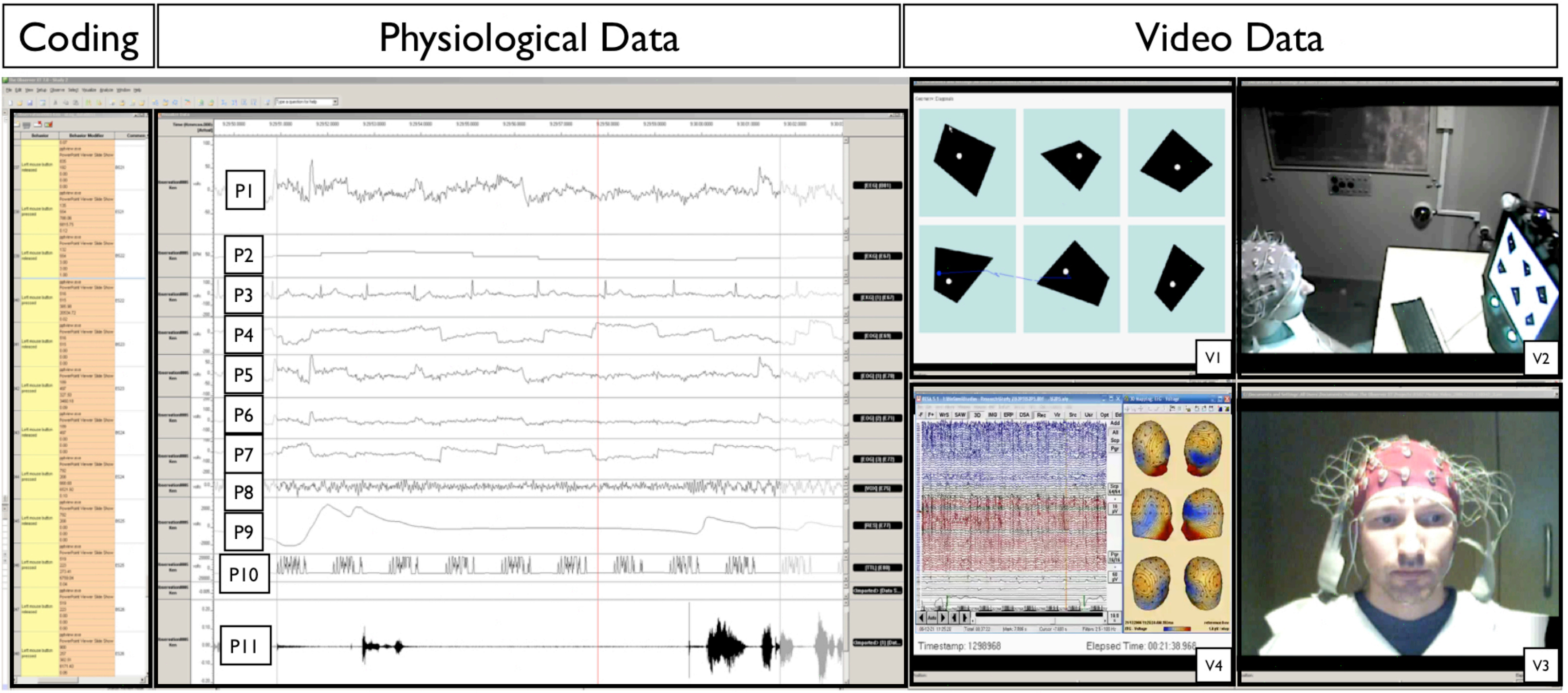
The leftmost column is for coding for the observation. The physiological data includes P1, the central EEG channel; P2 is the heart rate in beats per minute; P3 are heart beats from which P2 was derived; P4 and P7 capture horizontal eye-movements, whereas P5 and P6 capture the vertical eye-movements (using electrooculography, EOG); P8 measures muscle movements (using electromyography, EMG) from the back of the neck; P9 is respiration; P10 the time code; and P11 is the voice channel. Video data: V1 screen captures the eye-tracking as the participant views a slide from Dehaene, et al’s instrument; V2 and V3 video recordings of the participant; and V4 the full EEG data set.
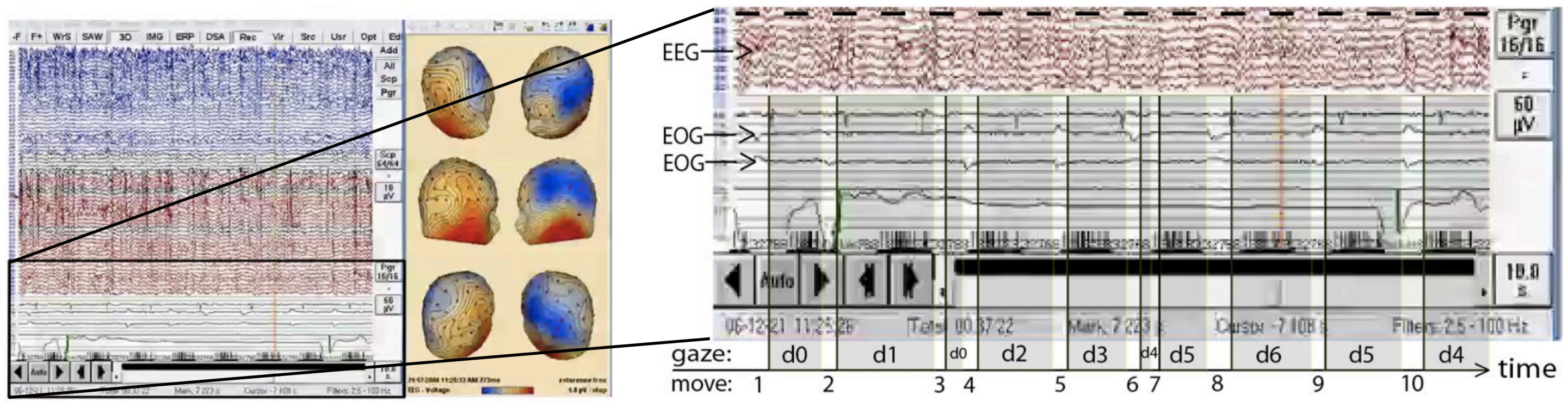
Figure 2 below illustrates how EOG data can be used to identify gaze areas (d0 through d6) and movement intervals (1-10) and their associated times in the physiological data to integrate with the eye-tracking data (corresponding to and illustrated in Figure 5 below).
A key premise of the approach I’ve taken to educational neuroscience is that theories, results, and methods of the neurosciences, cognitive neuroscience and psychophysiology in particular, can serve to augment and validate, not replace, traditional methods of educational research. These observations were part of a qualitative study in mathematics education research. The behavioral data provided by audiovisual data, coupled with the eye-tracking clearly indicated that an “aha!” moment occurred. So, then, what did the educational neuroscience tell us?
As noted above, a hallmark of the transcendental approach I’ve taken to educational neuroscience has been to draw upon methods, results, and findings from the neurosciences, and especially from the cognitive neurosciences. In this case, I drew upon results that clearly identify neural correlates of the “aha!” moment (Jung- Beeman, Bowden, Haberman et al, 2004; Bowden & Jung-Beeman, 2006). In two landmark experiments, Jung-Beeman, et al (2004) identified and located the neural correlates of an insight effect using EEG and fMRI. In the EEG experiment, the red line in the lower panel on the left side of Figure 3 below identifies an increase in gamma range power during moments of insight in contrast to the blue line where no insight was reported. Time zero on the horizontal scale designates the moment when participants reported the insight by pressing a button. The leftmost topographic maps of the right and left hemispheres show grand averages of EEG power distribution prior to the onset of the gamma burst (-1.52 to -.36ms), while the rightmost topographic maps show grand averages during the onset of the gamma burst, prior to the button press (-30ms to -.02ms).

Jung-Beeman et al’s fMRI experiment (upper panel on the left-hand side), cross-validated and located the effect in the anterior superior temporal cortex (ASTC). The question for us, given the behavioural evidence we had of an “aha!” moment, was whether an increase in EEG gamma power was evident in the vicinity of our participant’s ASTC. Independent component analysis (Delorme & Makeig, 2004; Makeig, Bell, Jung, & Sejnowski, 1996) was used to isolate different sources within our EEG data, and found the component illustrated on the right side of Figure 3.
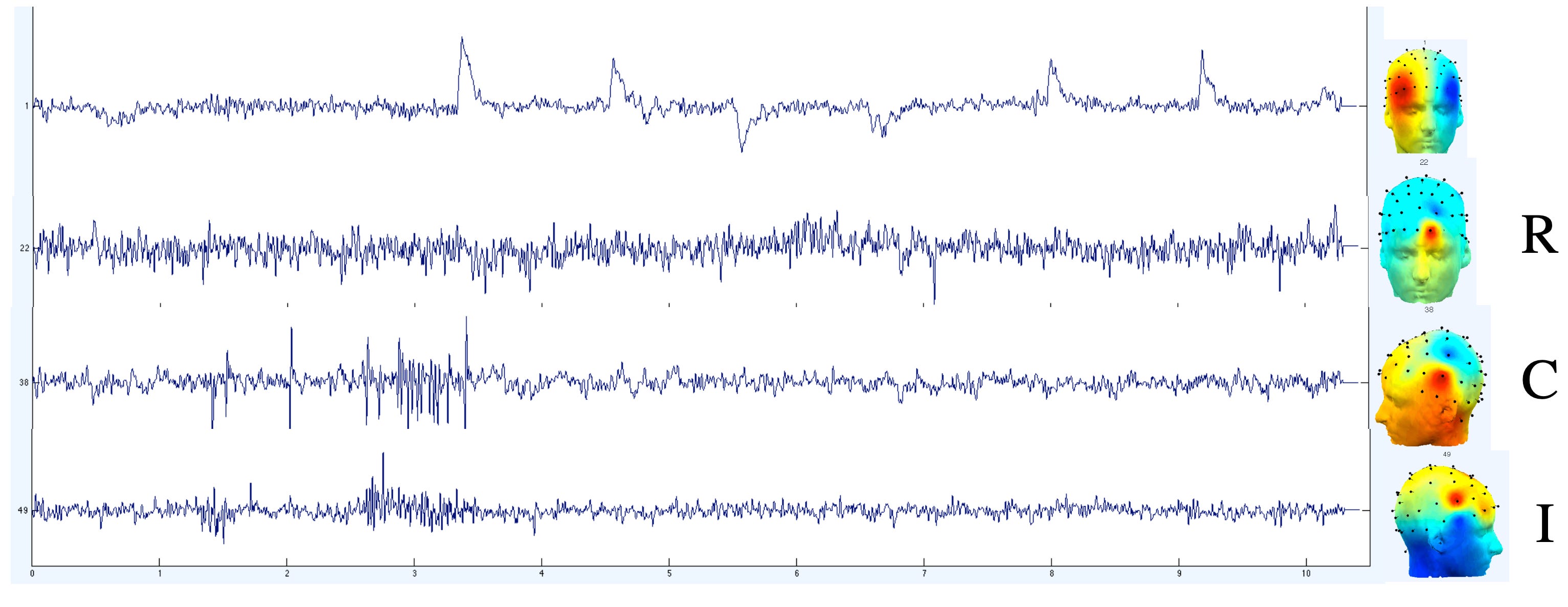
Cutting to the quick here, Figure 4 (above) illustrates four independent components of EEG data acquired in my lab from the participant over this approximately 10 second interval are presented in Figure 3 below. From the top, the first component captures and isolates the participant’s lateral eye movement. The spikes correspond to the vertical displacements from the EOG data (P7 in Figure 1). Second from the top in Figure 3 is an EEG component, labeled R, illustrating on-going activity in the participant’s slightly left dorsolateral Prefrontal Cortex (dlPFC) associated with spatial reasoning, working memory (Knauff, Mulack, Kassubek, et al, 2002), and implicated in integrating verbal and spatial representations (Barbey, Koenigs, & Grafman, 2013). Third from the top, labeled C, is sourced in proximity to Broca’s and Wernicke’s areas in the left hemisphere, responsible for speech and comprehension respectively. Most germane here is the bottom component labeled I in which the burst of energy in the gamma range is evident in close vicinity to the ASTC, associated with the insight effect.
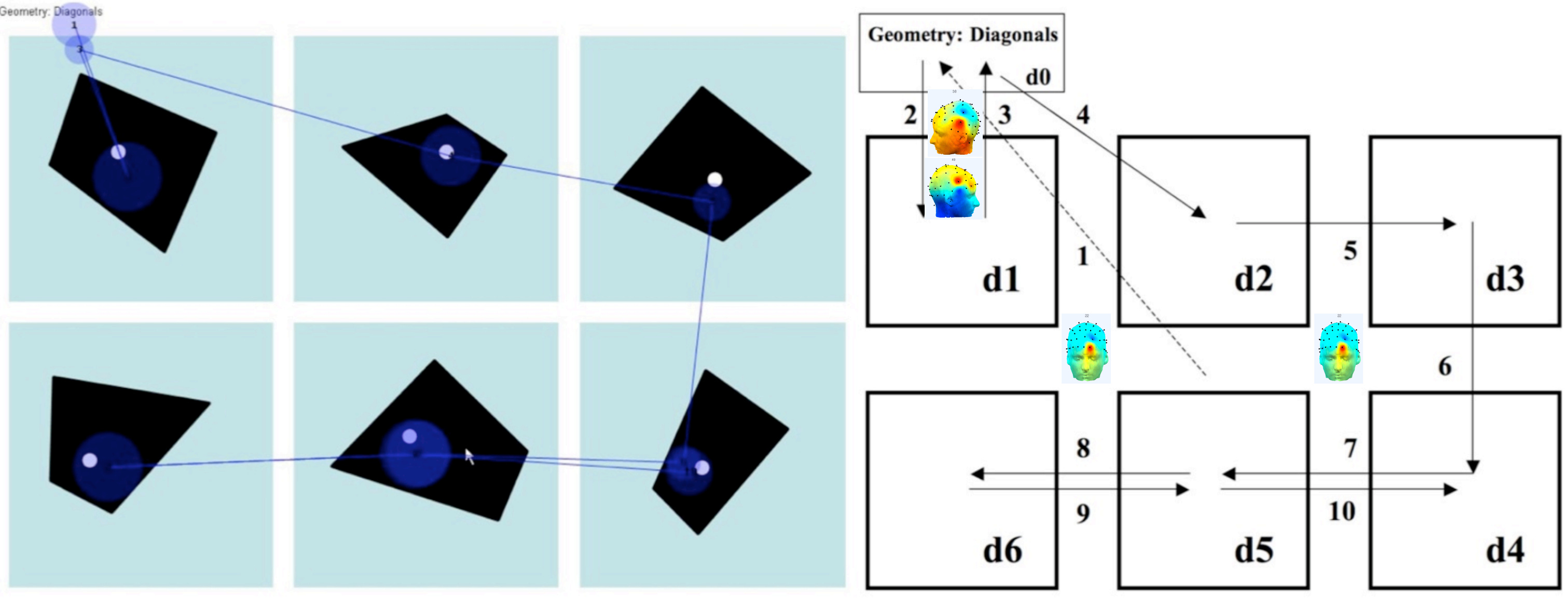
The left-hand side of Figure 5 (above) illustrates the eye-tracking data. After having been given two previously unsuccessful opportunities to identify the “odd ball” in this slide the participant’s gaze was initially oriented toward the centre of the screen when this slide reappeared for his consideration for the third time (now with prompt terms revealed which had been previously masked). Hence, his first action was to immediately move his eyes directly toward the prompt phrase “Diagonals”. The blue lines on the left-hand side of Figure 5 track his eye movements, while the blue circles indicate the locations where he held his gaze. The larger the circle, the longer the gaze interval. Eye movements and eye gazes are schematized on the right-hand side of Figure 5. The participant’s eye movements (with higher frequency saccadic jitter filtered out) are sequentially indicated by the numbers 1 through 10, whereas the area of the prompt phrase is designated as d0, and the six diagrams d1 through d6, in the order in which they were first viewed by the participant.
It is clear that the participant read the word “Diagonals” silently at d0, then, as he shifted his gaze to d1 he took a breath (see P9 in Figure 1) and articulated the word “diagonals” (as evidenced in the voice recording P11 in Figure 1). As he did so, as the idea of diagonals associated with the word became the focal point of his intentional consciousness, his gaze returned to d0, presumably as confirmation (verification) at about the 2.5s mark into the onset of the presentation of the slide. He then continued quite systematically and relatively quickly to shift his gaze to d2, d3, and d4. When he came to d5, it is evident that his gaze lingered a little longer. He then continued to d6, then returned to d5, at which point he clicked his tongue (see P11 in Figure 1), took a breath (P9 in Figure 10), and then exclaimed “Ahhh!” as he continued back to d4. The participant went on to describe his insight as follows:
Okay, yes, I see this quite differently now [than he was seeing this slide during his unsuccessful attempts to identify the oddball]. This, this one, um, in particular [referring specifically to this slide] I see very differently. I can see, if I mentally imagine a line [while looking at d1 and moving his cursor diagonally from the upper left corner to the lower right corner, then from the left corner to the right corner] connecting the diagonal edges [sic], I can see that this dot [while looking and pointing to the white dot in the centre of d1] is on that line. This dot [looking now at d2] is also on that line, this dot [d3] is on that line, this dot [d6] is on that line, this dot [d5] is not, and this dot [d4] is on that line. So here [d0], when I see the word “diagonals”, it definitely prompted me for what to look for, and I clearly see that this one [d5] is the one, is the only one that the dot is not on the diagonal.
So, when exactly was his “aha!” moment? Clearly, as illustrated in Figure 4, there was an attunement of sorts for our participant regarding the C and I components of his brain activity as recorded by EEG. Given that the C component was a neural correlate of comprehension as he read the term “diagonals” and that the I component was a neural correlate of insight as he connected that term to the criterion he had been seeking to identify the oddball figure, the R component appears to correlate with his assessing of the validity of that insight.
Koestler notes: “The sudden activation of an effective link between two concepts or percepts, at first unrelated, is a simple case of ‘insight’” (1967, p. 590). Does component I signal a spontaneous bisociative connection or link between, in this case, the participant’s comprehension of ‘diagonal’ and the synthesis of that comprehension with the perception of the dot on the diagonal (d1 in Figure 5) coupled with his unfolding realization that ‘diagonal’ was indeed the criteria the participant had been seeking to identify the oddball (d5 in Figure 5)? The eye-tracking and audiovisual data, in tandem with results from the EEG data appears to support this interpretation.6
There is widening acceptance and growing evidence that various modalities of consciousness, and mind more generally, are manifest within the dynamic fluctuations of the electromagnetic field generated by neuronal activity (e.g., Jones, 2013, 2017). Exactly how characteristics of mind, such as the binding of subjective experience into a coherent and stable whole, our sense of identity and privacy of thought, let alone how other matters of thought and perception, memory and foresight, creativity and insight, are so embodied remain to be satisfactorily resolved, and remain topics of ongoing investigation.
As for the future of educational neuroscience, it seems more likely to me, after a number of years of promoting educational neuroscience in the transcendental sense that I have indicated above, whereby new philosophical frameworks are forged that are inclusive of lived human experience, that educational neuroscience will continue to prevail. That is, I see much of the past, present, and future of educational neuroscience unfolding as an applied cognitive neuroscience, elucidating biological underpinnings of mental processes.
Cognitive neuroscience, approached from a “hard” scientific orientation, has the luxury of focusing on various aspects of brain behavior in terms of neural structure, mechanisms, processes, and functions. On the other hand, neuroscience approached from a more humanistic orientation would have the luxury of not having to be concerned with trying to explain, or explain away, the lived experience of learners solely in terms of biological mechanisms or computational processes underlying brain behavior (Campbell, 2010).
I think educational researchers, at least those who think the brain actually does have something to do with informing our understandings of cognition and learning, would like to be informed by biological mechanisms and processes underlying learning, and perchance also have access to methods of cognitive neuroscience. As an educational researcher, however, my primary focus is not on the biological mechanisms and processes underlying or associated with cognition and learning. Rather, it is on the lived experiences of teaching and learning, along with the situational contexts and outcomes of those experiences.
The above considerations perhaps still hold out some hope for the possibility of a more humanist-oriented educational neuroscience, as a new area of educational research that is both informed by the results of cognitive neuroscience, and has access to the methods of cognitive neuroscience, specifically conscripted for the purposes of educational research into the lived experiences of embodied cognition and learning (ibid.).
One may speculate, if not fully anticipate, that at some point in the future, such matters will become sufficiently resolved to be of great practical significance for education. Consider the following possibilities: Dry electrodes arrays that can be comfortably worn by students like ball caps, capable of transmitting high spatial and temporal resolution EEG or MEG signals from each student in a classroom wirelessly to a central console, analysed for specific aspects of cognitive activity, and made available to the teacher in real time.
Although there are serious ethical issues associated with realising such a scenario, used in a responsible and sensitive manner, such a possibility could provide teachers with unprecedented insight into formative assessment and student learning. Moreover, such tools could provide invaluable information for the teacher regarding overall student engagement and effectiveness of their teaching in real time. Whether such a scenario will benevolently unfold as so envisioned, there can be little doubt that the neurosciences will continue to inform our understandings of cognitive phenomena such as insight and the “aha!” moment, along with many other aspects of cognition and learning at the nexus of mind and brain. How far into the future must we wait? Perhaps not too much longer.
References:
Barby, A. K., Koenigs, M., & Grafman, J. (2013). Dorsolateral prefrontal contributions to human working memory. Cortex, 49(5), 1195-1205.
Bowden, E. M., & Jung-Beeman, M. (2007). Methods for investigating the neural components of insight. Methods, 42(1), 87-99.
Bruer, J. T. (1997). Education and the Brain: A bridge too far, Educational Researcher, 26(8), 4–16.
Butterworth, B. (1999). The mathematical brain. Macmillan.
Campbell, S. R. (in press (2021)). The aha! moment at the nexus of mind and brain. In Czarnocha, B. & Baker, W. (eds.) Creativity of the aha! moment and mathematics education (pp. 365–397). Koninklijke Brill, The Netherlands.
Campbell, S. R. (2011). Educational neuroscience: Motivation, methodology, and implications. Educational Philosophy and Theory, 43(1), 7-16.
Campbell, S. R. (2010). Embodied minds and dancing brains: New opportunities for research in mathematics education. In B. Sriraman and L. English (Eds.), Theories of mathematics education: Seeking new frontiers, pp. 309-331. Berlin: Springer.
Churchland, P. S. (1989). Neurophilosophy: Toward a unified science of the mind-brain. MIT Press.
Dehane, S. (1997). The number sense: How the mind creates mathematics. NY: Oxford University Press.
Delorme, A., & Makeig, S. (2004). EEGLAB: An open source toolbox for analysis of single-trial EEG dynamics including independent component analysis. Journal of Neuroscience Methods, 134, 9–21.
Gardner, H. (1987). The mind’s new science: A history of the cognitive revolution. NY: Basic Books.
Geake, J. (2008). Neuromythologies in education. Educational research, 50(2), 123-133.
Haugeland, J. (Ed.). (1981). Mind Design: Philosophy, psychology, artificial intelligence. Cambridge, MA: The MIT Press.
Jones, M. (2013). Electromagnetic-field theories of mind. Journal of Consciousness Studies, 20(11-12), 124-149.
Jones, M. W. (2017). Mounting evidence that minds are neural EM fields interacting with brains. Journal of Consciousness Studies, 24(1-2), 159-183
Jung-Beeman, M., Bowden, E. M., Haberman, J., Frymiare, J. L., Arambel-Liu, S., Greenblatt, R., ... & Kounios, J. (2004). Neural activity when people solve verbal problems with insight. PLoS biology, 2(4), 500-510.
Knauff, M., Mulack, T., Kassubek, J., Salih, H. R., & Greenlee, M. W. (2002). Spatial imagery in deductive reasoning: a functional MRI study. Cognitive Brain Research, 13(2), 203-212. =
Koestler, A. (1967). The ghost in the machine. Hutchinson.
Makeig, S., Bell, A. J., Jung, T.-P., & Sejnowski, T. J. (1996). Independent component analysis of electroencephalographic data. In D. Touretzky, M. Mozer, & M. Hasselmo (eds.), Advances in Neural Information Processing Systems (Vol. 8, pp. 145–151). Cambridge, MA: MIT Press.
McClelland, J. L., Rumelhart, D. E., & PDP Research Group. (1986). Parallel distributed processing: Explorations in the Microstructure of Cognition, Volume 2: Psychological and biological models. Cambridge MA: The MIT Press.
McCulloch, S. C. (1989, Mar.). An interview with Rita Peterson. Online at http://s3-us-west2.amazonaws.com/ucldc-nuxeo-ref-media/39305e95-b3a9-4ca3-a0ea-aae580a2afc4
Rumelhart, D. E., McClelland, J. L., & PDP Research Group. (1986). Parallel distributed processing: Explorations in the Microstructure of Cognition, Volume 1: Foundations. Cambridge MA: The MIT Press.
Tokuhama-Espinosa, T. N. (2008). The Scientifically Substantiated Art of Teaching: A study in the development of standards in the new academic field of neuroeducation (mind, brain, and education science). PhD thesis, Capella University, Minneapolis, MN.
Varela, F. J. (1996). Neurophenomenology: A methodological remedy for the hard problem. Journal of Consciousness Studies, 3(4), 330-349.
Varela, F. J., Thompson, E., & Rosch, E. (21991). The embodied mind: Cognitive science and human experience. Cambridge, MA: MIT press.
My gratitude to Ana and her colleagues for the kind invitation.
With minor edits, some of my presentation slides, additional links, and these footnotes.
By “blame” I mean “thank” :^)
To make a long story short, one that I might post more about in the future.
My bad. It was actually George H. W. Bush that designated the 1990s as the “Decade of the Brain.” This designation was formalized by presidential proclamation on July 17, 1990, following a Joint Resolution passed by the U.S. Congress (H.J.174) on July 25, 1989.
There were more data in my presentation on various other topics in educational neuroscience than were in the proceedings. I’ll try to get around to posting more on those at some point as well.
Regarding the topic of your work, the phrase "social construction of a new sense of perception" for seismic imaging realy sparked a reflective thought about how AI could also reshape human experience.